










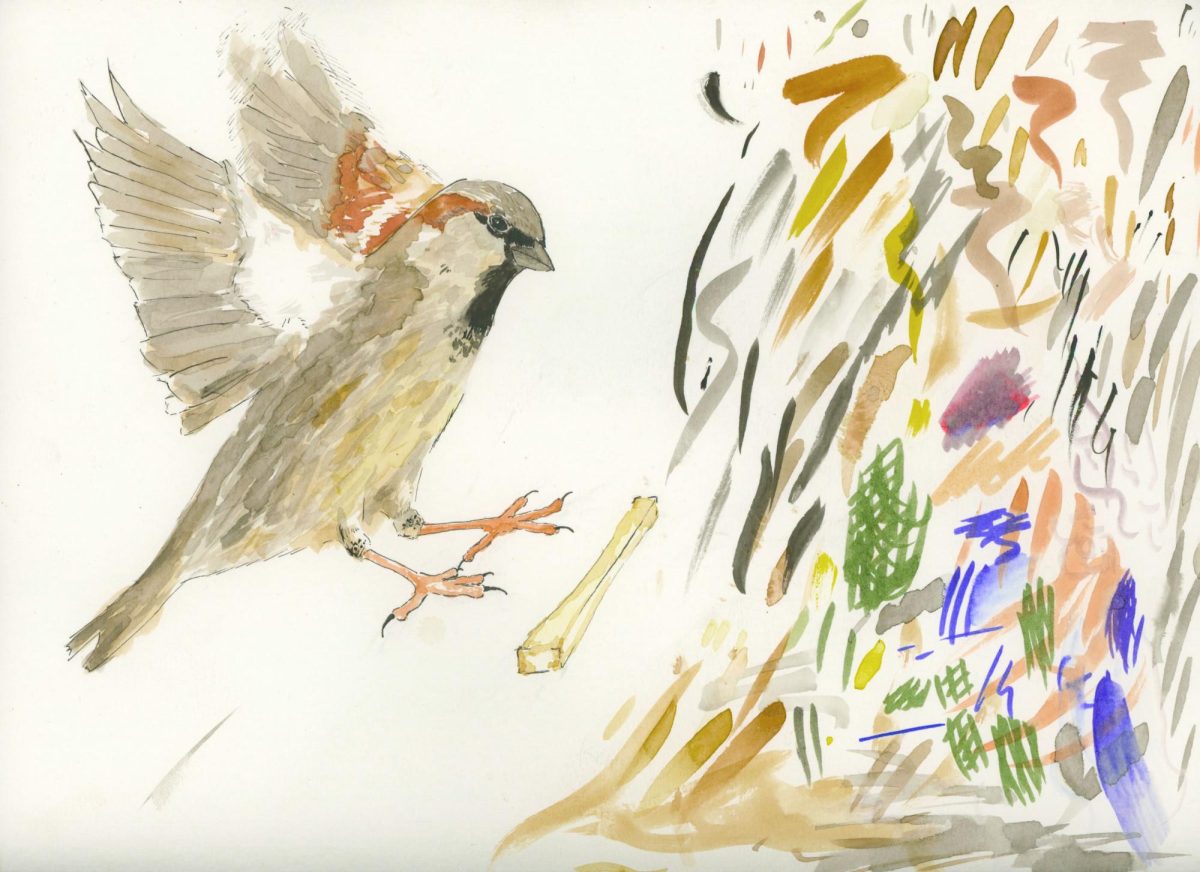
At the start of the school year, several students noted that a small bird had made its way into the commons. Although this is uncommon, it is not unheard of, and many expected it would exit the building within a few days. What students did not know was that the bird had already been in the building for a month, and that it was not going anywhere soon. What started as a little nuisance turned into a three month long headache for admin, and a small achievement for students who spotted the elusive resident.
“We started noticing in July that this bird was in the building. We thought we’d get it out but it just stayed,” Mathew Bayer, Athletic Director, said.
Admin at first thought nothing of the bird, assuming it would fly out eventually.
“School starts back up and we have inservice, parent meetings and students coming in the building while the bird is still just flying around,” Bayer said.
Bayer realized the bird was here to stay when he would prop the doors open and it would sit defiantly above the opening, as if taunting him that it wasn’t going anywhere. Students soon began to notice the bird as well.
“I was like ‘how is it still alive’ because I saw it 7 times over a few weeks,” Hernan Rivas, Trade senior, said.
The bird became a sort of Easter egg as students would spy it flying around the commons during quieter times of day. Admin eventually realized something had to be done
“Mr. Meng called in Wildlife & Parks, they came in and set out food with traps so we could get it and release it, but it wouldn’t eat the food so that wasn’t working,” Bayer said.
The bird had a feast available each day as students would see it eating up crumbs after lunch.
“It was probably divebombing trash cans for French fries,” Rivas said.
Lucas Moll, Zoology teacher, was not at all surprised that the bird managed to feed itself and survive inside the building.
“Birds are very good at finding food, especially if it’s one that survives our winters out here. In a cafeteria there’s plenty of food around,” Moll said.
It was more of a mystery how the bird managed to stay hydrated. Student theories ranged from water fountains to toilets.
“If there’s some pipes in the ceiling with condensation it could be drinking enough water from that. Birds like that do need to bring in a lot of calories and water but they’re good at finding sources,” Moll said.
Wherever its sources were, the bird had plenty to thrive On for the three months it remained in the school. Admin did not want to kill the bird, and so they kept attempting traps. The bird never fell for the plan, and with droppings having to be cleaned up it was becoming a sanitation issue. Thankfully an opportunity soon presented itself.
“One day we were all sitting out in the commons, and we noticed it had flown into the kitchen. I saw it and I said ‘hey everybody lets go.’ We got a couple principles to go stand at both entrances and I went to shut the doors,” Bayer said.
The kitchen is a much smaller space and was much easier for them to work with. Bayer knew the bird would not fly near people and so he stationed people at each entrance to the kitchen. He then closed as many doors in the kitchen as he could, stationed more people at possible exit points and opened a door leading out of the school. This created an L-shaped tunnel leading to the outside world. What ensued was essentially a Hail Mary football play that had been three months in the making.
“We stood there with big boxes held up so it wouldn’t fly back to the kitchen. The cooks opened the door and it flew right at us and then went through the L and out the door,” Bayer said.
The final process involved Bayer, Mr. Meng, all four academy principals, two cooks and three custodians for a total of 11 people. This squad was able to funnel the bird to its natural habitat. Admin is grateful to not have to deal with the nuisance anymore, and many students are missing the presence of their unofficial, now escaped, mascot.